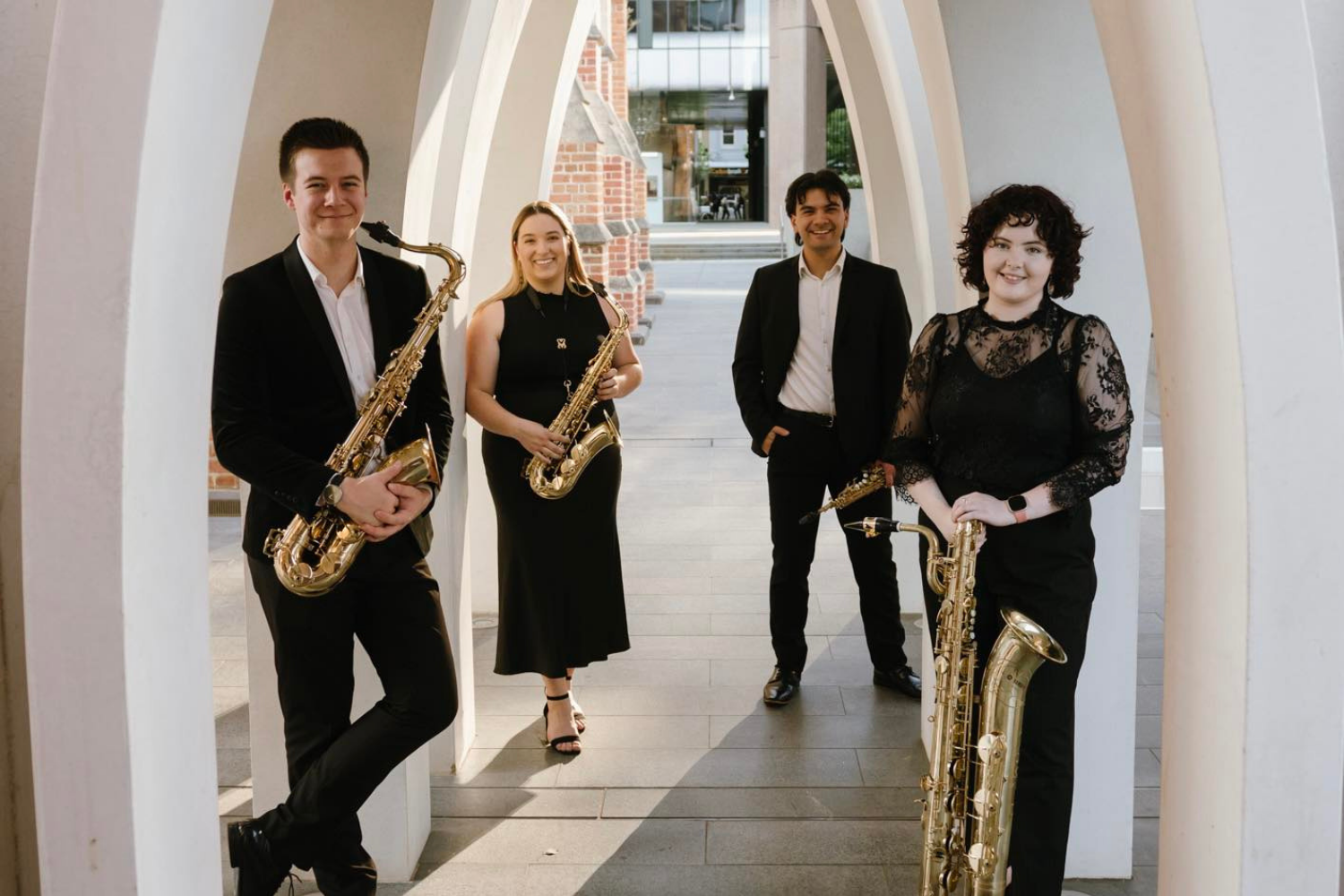
Symbios Quartet
Programme
JC MAYNARD The Onyx
Felix MENDELSSOHN arr. Bruce A. Evans Capriccio, Op. 81
Chris Evan HASS Polar Vortex
I. Snowfall
II. Bloodthirsty Blizzard
Leonard BERNSTEIN arr. Ph. Marillia Selections from Westside Story
Overture
Tonight
Maria
America
Mambo (Dance at the Gym)
Short Intermission
Guillermo LAGO Ciudades
III. Addis Ababa
Arturo MÁRQUEZ Danzon No. 5 (Portales de Madrugada)
Antonin DVOŘÁK arr. Edward Andrews String Quartet No. 12 in F Major, Op. 96 (American)
I. Allegro ma non troppo
II. Lento
III. Molto Vivace
IV. Vivace ma non troppo
Johann Sebastian BACH arr. Anon Fugue in G minor, BWV 578 (Little Fugue)
Artists
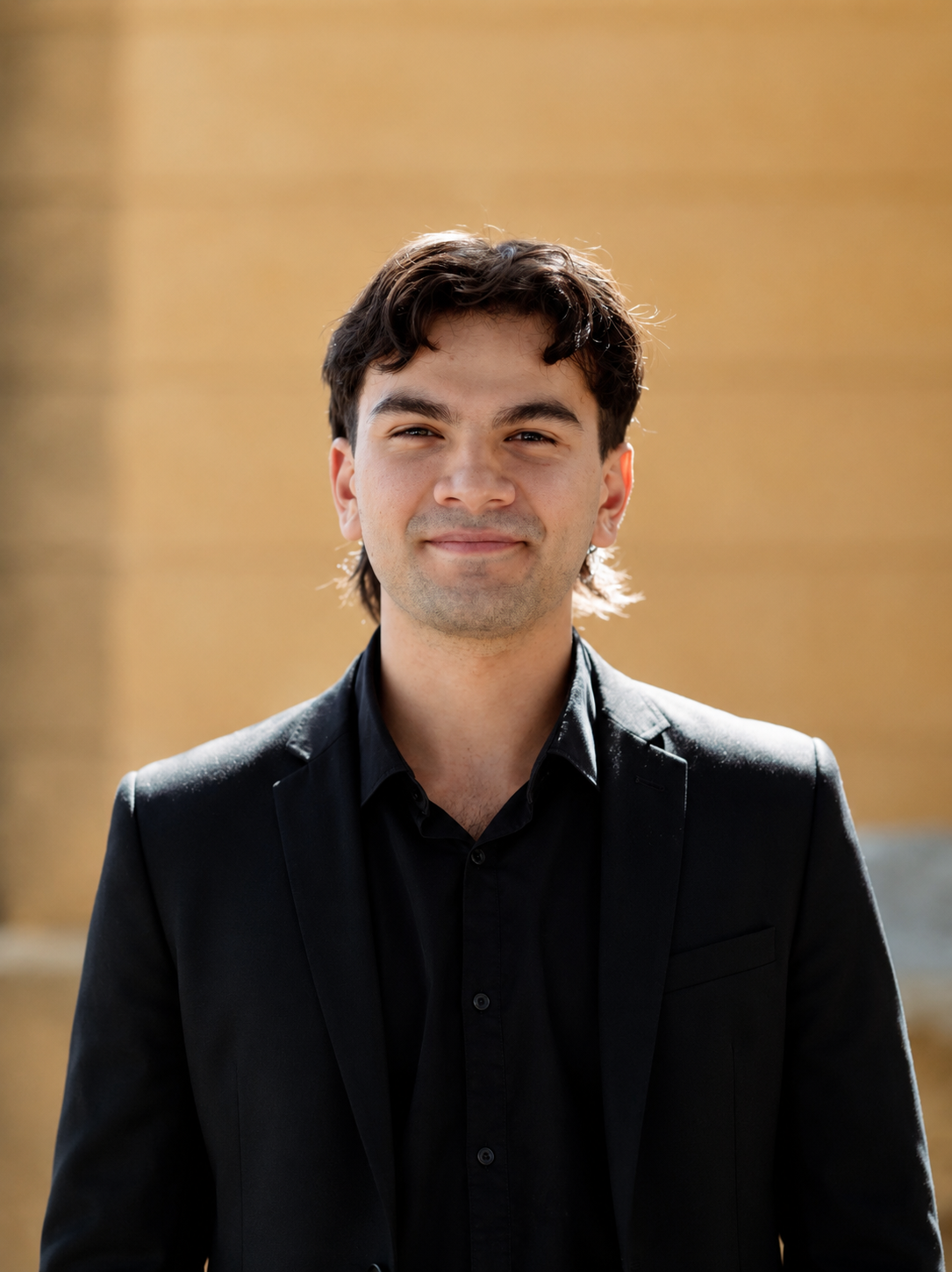
Joshua Sumich
Soprano Saxophone
Joshua Sumich graduated with an Honours degree in Classical Saxophone from the Western Australian Academy of Performing Arts (WAAPA), where he studied with Dr Matthew Styles and Nikki Demandolx. He also holds a Master of Education from the University of Western Australia, complementing his performance experience with a foundation in music education.
-
At WAAPA, Joshua performed in orchestral, wind, jazz and musical theatre settings, including productions at His Majesty’s Theatre. He has performed with the Western Australian Youth Orchestra, playing soprano saxophone in Ravel’s Boléro, and at festivals including the Perth Jazz Festival, Froth Town Festival, Winter Arts Festival and Fringe Festival. With Junkadelic Brass Band, he toured to Port Hedland for the 2024 Spinifex Spree Carnival.
Joshua is a member of Lost Valley Hotel, which released the EP Phantasm Market and is developing a new album. The group performs at venues throughout Fremantle.
As a vocalist, Joshua performs with Voyces, directed by Dr Robert Braham OAM. Through the ensemble, he has collaborated with VOCES8, the West Australian Symphony Orchestra and chamber choirs from across Australia. He also performed in the 2023, 2024 and 2025 National Youth Choir of Australia seasons and with Gondwana Chorale at the Gondwana National Choral School.
Joshua continues to develop as a conductor through a mentorship with the Metropolitan Symphony Orchestra under Dr Ronald Thomas AM and his role as assistant conductor of the Armadale Concert Band. His work reflects a passion for performance, conducting and education, supported by a dedication to refining his craft.
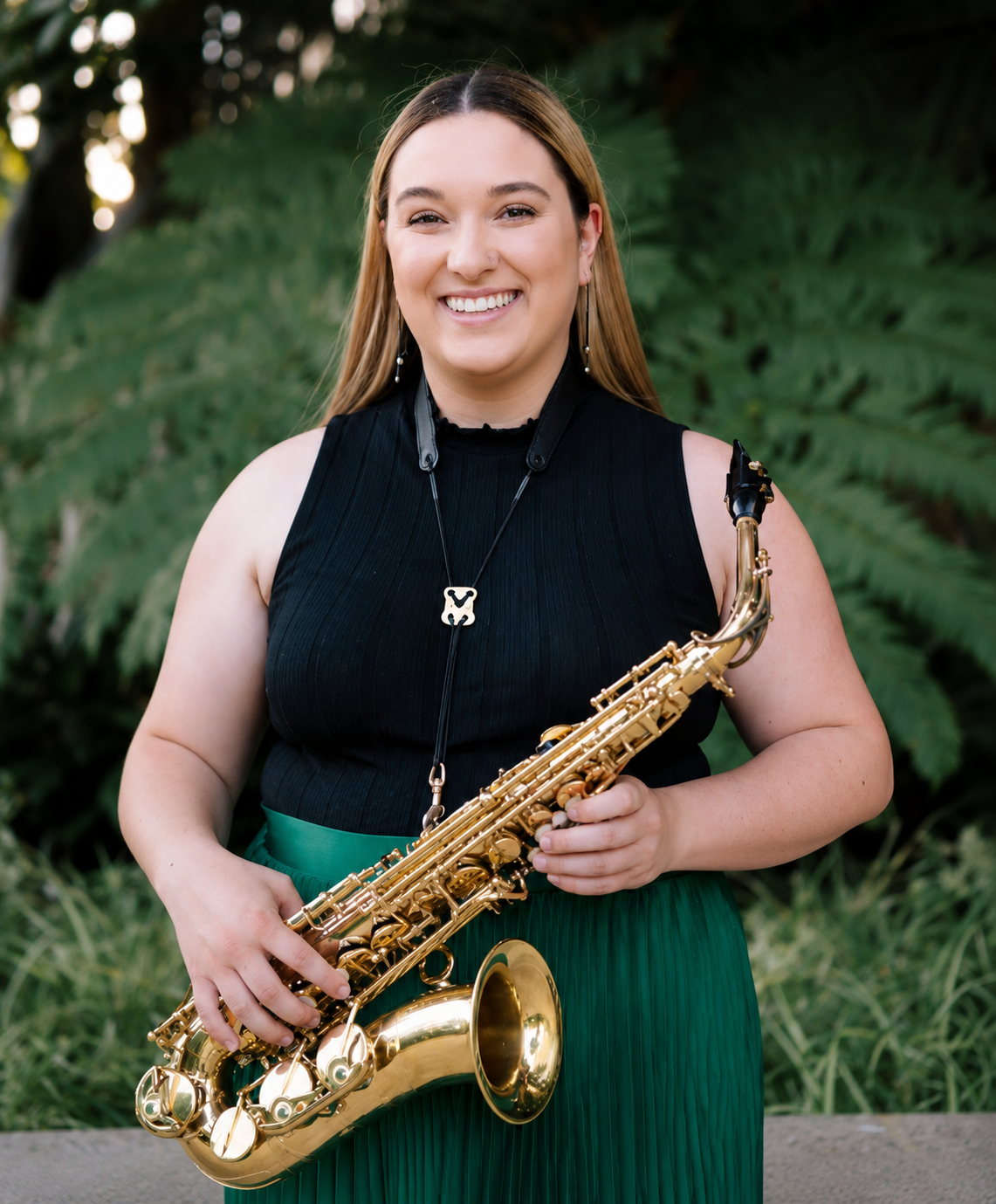
Grace Kay
Alto Saxophone
Grace Kay is a classically trained saxophonist who holds a Bachelor of Music with Honours from the Western Australian Academy of Performing Arts (WAAPA). Studying under Dr Matt Styles and, earlier, Dr Erin Royer, she developed an appreciation for a wide range of musical genres and a particular interest in the saxophone’s versatility.
-
Inspired by her musical family, Grace began learning piano in primary school before selecting the saxophone as her principal instrument in high school. She also studied percussion for several years, an experience that strengthened her understanding of rhythm and continues to inform her approach to performance.
Grace has appeared as a soloist at venues including St Mary’s Cathedral and Perth Concert Hall. She has performed with the WAAPA Symphony Orchestra, ‘Phone Co. and the Symphonic Wind Ensemble, and regularly plays in musical-theatre orchestras at the Regal Theatre. Other highlights include Portia Clark’s Women of Our Time tour and Awesome Festival’s Sax to the Max. In 2023, she was selected as a finalist for the Richard Gill Award.
An experienced teacher, Grace has taught saxophone and clarinet privately and at several Perth secondary schools. She particularly enjoys directing saxophone ensembles and creating opportunities for students to make music together. Her teaching encourages curiosity, with students invited to understand the reasoning behind each new musical concept.
Grace has performed on instruments ranging from the sopranino to the bass saxophone and especially enjoys nuanced, creatively composed repertoire. Beyond music, she presents science shows at Scitech, combining her scientific interests with the stagecraft developed through her musical training.
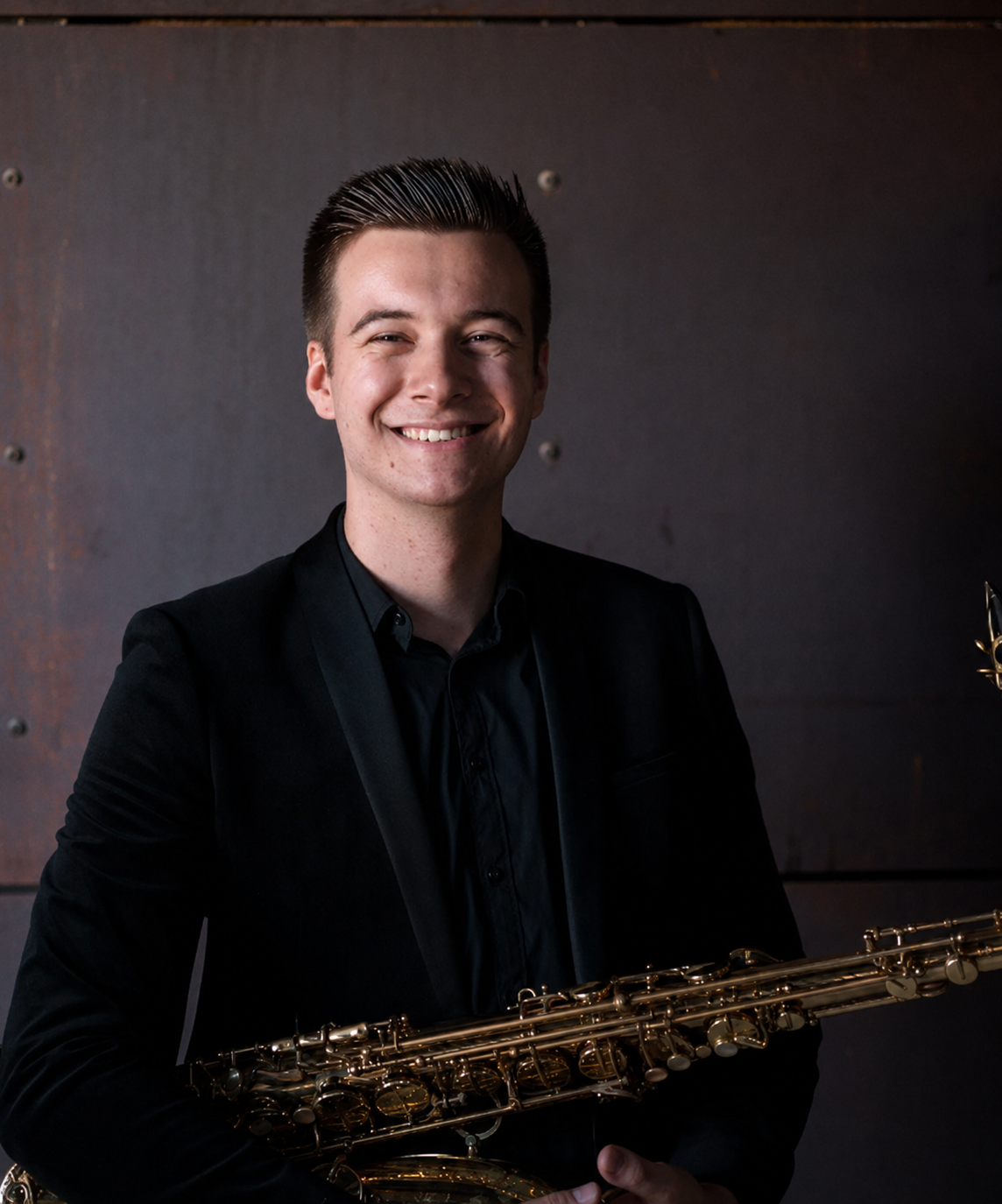
Blake Bayley
Tenor Saxophone
Blake Bayley is a Perth-based saxophonist whose work spans classical, jazz, musical theatre, and traditional music. A graduate of the Western Australian Academy of Performing Arts (WAAPA), he is passionate about projects that blur stylistic boundaries and bring diverse musical traditions together.
-
This interest has led to performances in a wide range of settings, including an appearance with the West Australian Symphony Orchestra under the baton of Otto Tausk in Steve Martland's Danceworks, a landmark work celebrated for its fusion of contemporary classical and popular musical influences.
Blake is the tenor saxophonist and a founding member of the award-winning Symbios Quartet, performing repertoire that showcases the versatility and expressive potential of the saxophone. He performs across the full saxophone family, from soprano to baritone, and has collaborated extensively with musicians from a broad range of musical backgrounds.
An accomplished woodwind doubler, Blake has built an extensive career in musical theatre. His performance credits include WAAPA's productions of Crazy for You at His Majesty's Theatre, Cabaret, and Side Show, alongside productions of Anything Goes, Legally Blonde, and Grease with other theatre companies. He also performed with the West Australian Youth Jazz Orchestra, further broadening his experience across genres.
Blake's musical identity is deeply influenced by his New Zealand Māori and Scottish heritage. His interest in Māori musical traditions led him to study the kōauau, a traditional Māori flute, while he also performs on the Great Highland bagpipes with the Perth Metro Pipe Band at concerts, ceremonies, and community events.
Whether performing in the concert hall, theatre pit, or chamber setting, Blake is committed to exploring music that connects genres, cultures, and audiences.
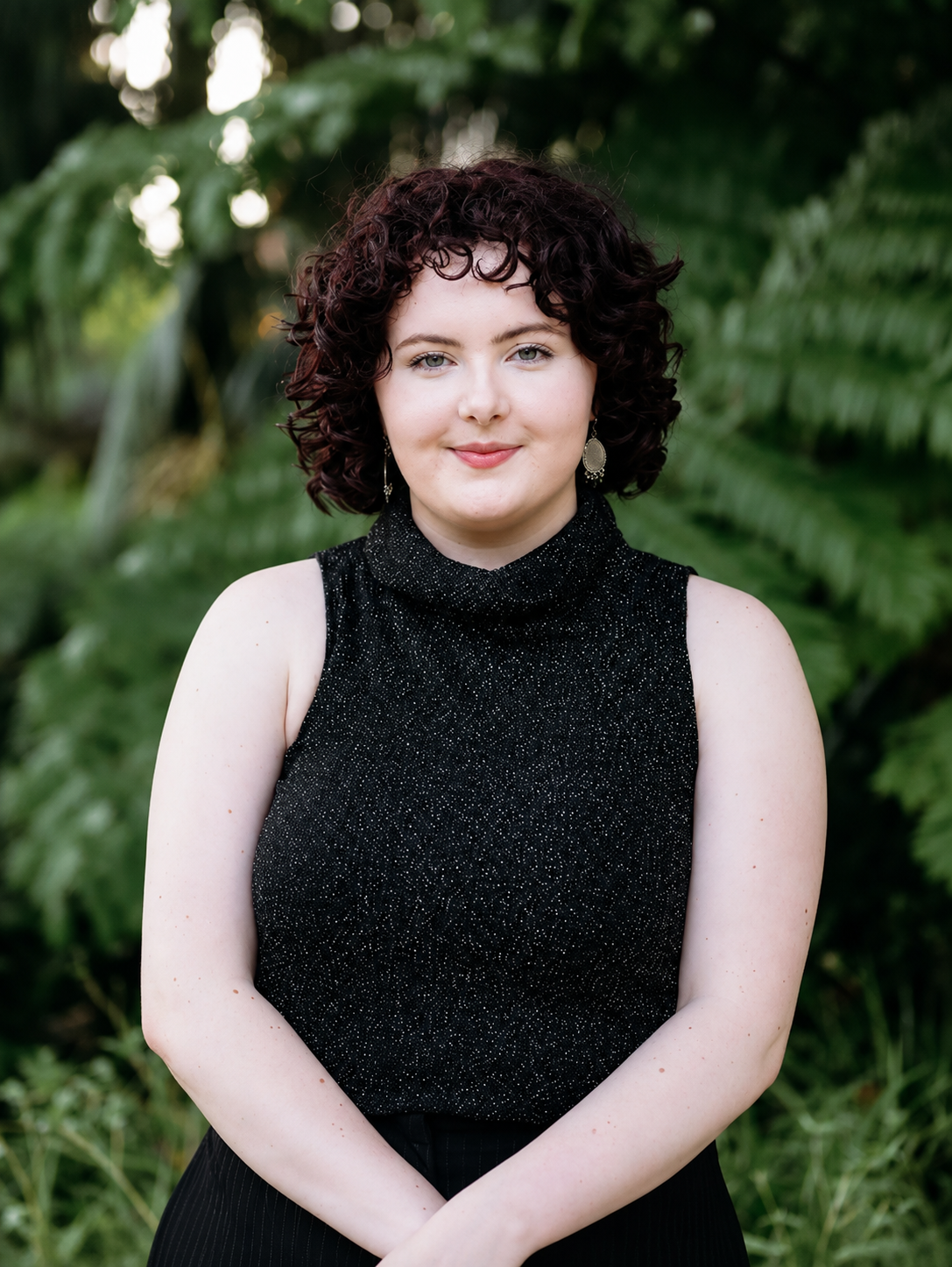
Andrea Jordan-Keane
Baritone Saxophone
Andrea Jordan-Keane is an Australian saxophonist of Irish heritage whose musical identity combines classical training, contemporary performance, improvisation and Celtic influence. She began playing saxophone after receiving a music scholarship to John Curtin College of the Arts in 2015 and graduated from the Western Australian Academy of Performing Arts (WAAPA) in 2024.
-
At WAAPA, Andrea performed with Phone Co., the Symphonic Wind Ensemble and musical theatre productions including Mack and Mabel, Cats and Legally Blonde. Her interest in jazz led her to the WA Youth Jazz Orchestra, performing with the Minter Ellison Monday Night Orchestra in 2022 before earning the Alto 1 chair in the Tuesday Night Orchestra in 2025. This experience strengthened her confidence and versatility as an improviser.
Andrea has performed with the Perth Sax Rockers at festivals across Perth and Fremantle. As an arranger, she writes for solo saxophone, duos, quartets and larger ensembles. Her arrangement of Scarborough Fair was performed by Symbios Quartet at the 2023 WA Saxophone Consortium Concert.
Her contemporary work includes performing as the improvising saxophonist for Ben Lee’s sold-out Western Australian concert in 2025. She has also performed in tribute productions in Broome and Adelaide and presented a solo Sax + DJ set for the 2026 Rottnest Marathon.
Andrea is the founder and bandleader of Echo of Aphrodite, an all-female funk ensemble that debuted at the 2025 Women in Jazz Festival. Working across classical, jazz and contemporary music, she embraces opportunities ranging from chamber premieres and arrangements to spontaneous improvisation before large audiences.
About the Music
JC MAYNARD The Onyx
-
The Onyx transports its audience into the smoky, seductive atmosphere of an exclusive and thoroughly disreputable nightclub. It is a fictional world populated by high rollers, organised-crime figures and forbidden lovers, where glamour and danger are never far apart. Composer J. C. Maynard drew inspiration from a book he was writing, transforming its imagined den of vice into a vivid piece of musical theatre without words.
Written in 2024 and premiered by the Nois Quartet, The Onyx embraces jazz and film-noir conventions while treating both with an irreverent sense of humour. Its opening evokes the mysterious woman seated in the corner with a cigar, her slow and sultry ballad unfolding against the club’s shadowy surroundings. The music soon becomes more animated, however, as the listener is drawn from this intimate portrait into the raucous commotion of the casino floor.
Maynard makes colourful use of the ensemble’s contrasting registers and personalities. Smooth melodic lines and richly blended harmonies suggest the allure of the club, while sharper rhythms, instrumental interjections and deliberately unruly sounds expose the corruption beneath its polished surface. Passages of apparent sophistication can suddenly give way to noise and disorder, as though the room’s elegant façade is repeatedly slipping.
The result is a compact musical scene that moves freely between smoky jazz, cinematic suspense and uninhibited spectacle. Stylish, mischievous and slightly dangerous, The Onyx invites the audience through the doors of a place where respectable behaviour has been left outside.
The piece’s drama depends upon rapid changes of perspective. A phrase may begin as polished entertainment before being interrupted, distorted or overwhelmed by activity elsewhere in the room. Each voice can step briefly into the spotlight, only to be absorbed again into the crowd. These exchanges suggest fragments of conversation, private schemes and sudden confrontations unfolding simultaneously beneath the club’s carefully maintained appearance.
Even the more abrasive effects contribute to Maynard’s storytelling. They evoke clinking glasses, restless gamblers and the mounting confusion of a night in which pleasure and menace become indistinguishable. Its final flourish keeps that danger unresolved and deeply unsettling.
Felix MENDELSSOHN arr. Bruce A. Evans Capriccio, Op. 81
-
Felix Mendelssohn composed this Capriccio in Leipzig in 1843, four years before his death. It was published posthumously as the third of his Four Pieces for String Quartet, Op. 81, a collection assembled from independent movements written at different stages of his career. Although not originally conceived as a unified set, the pieces reveal Mendelssohn’s enduring fascination with the expressive and contrapuntal possibilities of chamber music.
The Capriccio begins with an Andante introduction of lyrical restraint. Its gently rocking accompaniment recalls a barcarolle, the traditional song of Venetian gondoliers, while the principal melody unfolds with the effortless grace characteristic of Mendelssohn’s writing. More declamatory passages interrupt this calm surface, lending the introduction something of the character of an operatic recitative.
The mood then changes decisively. The music accelerates into a vigorous fugue in E minor, built from the successive entrances and interweaving of a sharply defined principal idea. Mendelssohn’s admiration for Johann Sebastian Bach is unmistakable here. His celebrated 1829 revival of Bach’s St Matthew Passion had played a major role in renewing public interest in the older composer, and contrapuntal writing remained central to Mendelssohn’s own musical language.
Bruce A. Evans’s arrangement preserves the work’s four-part construction, allowing each instrumental line to emerge with clarity as the fugue gathers momentum. The contrast between the flowing introduction and energetic conclusion gives the work its distinctive character: poised at first, then increasingly animated, intricate and brilliant.
The title Capriccio suggests freedom, fantasy and an element of unpredictability, all qualities reflected in the movement’s striking change of character. Yet Mendelssohn’s control remains evident throughout.
Once the faster section begins, short ideas travel quickly through the ensemble. Entries overlap, accompaniment figures gain urgency and the texture becomes progressively more concentrated. Evans’s scoring highlights the distinction between individual voices without sacrificing the unified sonority essential to the music. Listeners can follow the subject as it moves between registers, while also hearing the answering lines that surround it.
This combination of Romantic expression and Baroque technique was fundamental to Mendelssohn’s style. He regarded older forms not as historical curiosities, but as living structures capable of renewed dramatic force. In the Capriccio, graceful melody and rigorous counterpoint ultimately reinforce one another, carrying the work from introspective calm to a conclusion of concentrated energy and brilliance.
Chris Evan HASS Polar Vortex
-
I. Snowfall
II. Bloodthirsty BlizzardChris Evan Hass’s Polar Vortex is a two-movement work inspired by a severe winter storm that struck Michigan in 2014. Rather than depicting a single frozen landscape, the piece follows the changing course of the weather, moving from the optimism and tranquillity of the first snowfall to the chaos and violence at the storm’s centre. The two movements are therefore strongly contrasted but together form a continuous dramatic journey.
Snowfall opens in an atmosphere of stillness and expectation. Slowly moving melodies and delicate textural figures imitate brief flurries of snow, while gradual harmonic changes lend colour and movement to an otherwise calm musical landscape. The writing alternates between gestures suggesting individual snowflakes and broader, more sustained lines, creating a scene that is both peaceful and quietly animated. Its lyrical character captures the beauty and novelty of the first fall, before the full force of the winter has become apparent.
In Bloodthirsty Blizzard, that serenity is swept aside. The tempo quickens and the musical surface becomes jagged, volatile and intensely rhythmic. Sudden changes of dynamics create the sense of a storm that shifts direction without warning, while persistent modulation prevents the music from settling comfortably into any one key. Material introduced near the beginning is developed and intensified as the movement progresses, giving the apparent chaos a strong underlying structure.
The diminished scale plays an especially important role in the second movement. Its alternating pattern of tones and semitones produces an unstable, biting harmonic colour, while the tonal centres of the movement’s major sections outline a diminished chord. These structural relationships bind the music together even at its most turbulent.
Across its two movements, Polar Vortex transforms a familiar Michigan winter scene into a compact dramatic narrative. What begins as a gentle contemplation of falling snow becomes an exhilarating struggle against an overwhelming natural force.
The relationship between the movements is more than pictorial. Their contrasting materials show how quickly wonder can turn into apprehension when nature escapes human control. Ideas that initially seem spacious and benign are replaced by compressed rhythms, abrupt accents and relentless forward motion. The ensemble must move between delicately balanced sonorities and passages of formidable precision, making the change in weather audible through texture as well as harmony.
Leonard BERNSTEIN arr. Ph. Marillia Selections from Westside Story
-
Overture
Tonight
Maria
America
Mambo (Dance at the Gym)Premiered on Broadway in 1957, West Side Story brought together composer Leonard Bernstein, lyricist Stephen Sondheim, playwright Arthur Laurents and choreographer-director Jerome Robbins. Inspired by Shakespeare’s Romeo and Juliet, the musical transfers the tragedy to mid-twentieth-century New York, where the rivalry between the Jets and the Sharks provides the setting for the doomed love of Tony and Maria. Bernstein’s score unites Broadway lyricism, jazz, Latin American dance rhythms and symphonic techniques with remarkable fluency.
Philippe Marillia’s arrangement distils the musical’s sound world into five contrasting episodes. The Overture introduces the score’s energy and tension, drawing on music associated with the rival gangs and the conflict that drives the drama. Angular rhythms and sharply profiled gestures establish an atmosphere in which excitement and danger are closely intertwined.
Tonight offers the first great contrast. In the musical, Tony and Maria sing of their love following their meeting at the dance. Bernstein’s expansive melody seems to suspend time, creating a private world removed from the violence around them. Its soaring phrases and shifting metre give the song both tenderness and a powerful sense of anticipation.
Maria captures Tony’s astonishment after learning the name of the young woman he has just met. The repeated name grows from a simple, intimate phrase into one of Bernstein’s most memorable melodies. Its opening notes employ the interval of a tritone, an unstable sound that appears throughout the score, yet here it is transformed into an expression of wonder.
America brings Latin dance rhythms to the foreground. Originally sung by the musical’s Puerto Rican characters, it combines infectious vitality with a spirited debate about the promises and disappointments of immigrant life in New York. Its alternation between groups of two and three beats creates the number’s characteristic rhythmic lift.
Finally, the Mambo comes from Dance at the Gym, where Tony and Maria first see one another. Driving syncopations, exuberant accents and shouted interjections turn the music into a brilliant display of competitive energy. The episode displays Bernstein’s gift for turning complex cross-rhythms into music of theatrical force and irresistible excitement.
Guillermo LAGO Ciudades
-
III. Addis Ababa
Guillermo Lago is the pen name of Dutch composer and saxophonist Willem van Merwijk. His Ciudades, meaning “Cities”, is an expanding series of musical portraits in which individual movements respond to places of personal significance. Rather than attempting literal descriptions, Lago draws upon memories, relationships and cultural impressions to give each city its own distinctive musical identity.
Addis Ababa portrays the capital of Ethiopia and was inspired by Lago’s collaboration with the Ethiopian-born singer and dancer Minyeshu Kifle Tedla. The work does not simply imitate Ethiopian traditional music. Instead, it filters elements of its rhythmic and melodic character through Lago’s contemporary musical language, producing a portrait shaped by personal encounter rather than distant observation.
Rhythm is central to the movement. Short, sharply articulated figures are repeated, displaced and passed between the four independent lines, creating an intricate sense of momentum. Against this rhythmic foundation, melodic ideas emerge in different registers and are answered or reinforced by the surrounding voices. The result is music that can feel simultaneously disciplined and spontaneous, with each player contributing to a constantly changing collective texture.
Lago’s writing exploits the unusual combination of blend and individuality available to four closely related instruments. At times the ensemble operates as a single resonant body; elsewhere, its voices separate into layered patterns or lively exchanges. Changes of register, articulation and density supply much of the movement’s colour.
Energetic yet carefully controlled, Addis Ababa captures the vitality of a city through musical motion. It forms one chapter in Lago’s broader musical atlas, in which geography becomes inseparable from memory, friendship and human experience.
The movement also reflects Lago’s intimate knowledge of the saxophone. A performer and teacher as well as a composer, he writes lines that are idiomatic yet demand attention to balance, articulation and rhythmic unanimity. Repeated patterns can function like a shared pulse, while freer melodic material seems to rise above the surrounding activity. The music’s momentum depends upon all four performers listening and responding as a single organism.
Addis Ababa therefore operates on two levels. It is an affectionate response to a particular place and cultural encounter, but it is also an abstract study in rhythm, colour and collective energy. The listener instead encounters an animated succession of impressions. Through motion, Lago creates a portrait that is personal, vivid and open-ended.
Arturo MÁRQUEZ Danzon No. 5 (Portales de Madrugada)
-
Mexican composer Arturo Márquez is celebrated internationally for transforming the danzón into vibrant concert music. Originating in Cuba and later flourishing in the dance halls and urban culture of Mexico, particularly in Veracruz and Mexico City, the danzón is characterised by elegance, sensuality and precisely shaped rhythmic patterns. Márquez’s series of concert danzones pays tribute to this tradition while extending it through his own sophisticated harmonic and structural language.
Danzón No. 5, composed in 1997, bears the subtitle Portales de madrugada, or “Arcades at Dawn”. The title evokes a public square or colonnaded street in the early hours of the morning, when the energy of the previous night has not entirely disappeared but the city is beginning to change. This suggestive setting is reflected in music that alternates between intimacy and animation.
The work begins with a sense of poise and expectancy. Melodic fragments emerge over restrained dance rhythms, creating an atmosphere that is languid without ever becoming static. As the music unfolds, its gestures become more rhythmically assertive. Syncopations sharpen, the texture grows denser and individual lines enter into animated conversation, suggesting dancers responding to one another across the floor.
Márquez balances refinement with physical energy. Seductive melodies and warmly coloured harmonies coexist with sudden accents, tightly coordinated rhythmic figures and bursts of exuberance. In its four-part form, the music can move rapidly between close ensemble blend and the independence of individual voices, preserving both the elegance and conversational character of the dance.
Portales de madrugada is less a formal ballroom dance than a vivid recollection of one. Its shifting moods suggest music heard through the haze of the early morning: graceful, nostalgic and still charged with the rhythmic excitement of the night.
The danzón traditionally values restraint as much as display. Dancers respond to subtle accents, pauses and changes of phrase, and Márquez preserves this sense of controlled anticipation. Moments of repose are never entirely still; beneath them lies a pulse capable of returning suddenly to the foreground. This tension between elegance and propulsion gives the work much of its distinctive character.
The four voices repeatedly exchange melodic and accompanying roles. A line introduced in one register may be answered elsewhere, decorated by another player or absorbed into a fuller ensemble texture. These exchanges unite the dance’s distinctive social and conversational qualities.
Antonin DVOŘÁK arr. Edward Andrews String Quartet No. 12 in F Major, Op. 96 (American)
-
I. Allegro ma non troppo
II. Lento
III. Molto Vivace
IV. Vivace ma non troppoAntonín Dvořák composed his String Quartet No. 12 during the summer of 1893, while staying in Spillville, Iowa. He had travelled to the United States the previous year to direct the National Conservatory of Music in New York but found the city exhausting. Spillville, with its rural surroundings and sizeable Czech community, offered a welcome sense of familiarity. Dvořák sketched the quartet in only three days and completed it within a further thirteen.
The nickname reflects its American origins. Pentatonic melodies, syncopated rhythms and repeated accompaniments mingle naturally with qualities already central to Dvořák’s Czech voice.
The Allegro ma non troppo begins with a broad principal theme, originally entrusted to the viola. Built largely from the five-note pentatonic scale, it immediately establishes the movement’s open and pastoral character. A more reflective second idea provides contrast, while rhythmic fragments from the opening supply energy throughout the development. The music’s formal clarity is matched by an easy flow of melody between the four voices.
The Lento is the emotional centre of the quartet. Over a persistent, gently pulsing accompaniment, a long and deeply expressive melody unfolds with the character of a lament. Its simplicity is deceptive: subtle changes of harmony, register and instrumental colour continually reshape the repeated material. Moments of greater intensity subside into quiet reflection, leaving an atmosphere of spaciousness and solitude.
The Molto vivace serves as the quartet’s scherzo. A lively, rhythmically incisive idea alternates with more relaxed episodes, creating a compact movement of quick contrasts. Dvořák reportedly associated one of its high, insistent figures with the call of a bird he heard while walking near Spillville. Whether heard as birdsong or simply as a striking musical gesture, it gives the movement a playful and distinctive profile.
The finale, Vivace ma non troppo, begins with an energetic repeated accompaniment beneath an exuberant main theme. Its forward momentum is interrupted by a quieter chorale-like passage, sometimes linked to Dvořák’s visits to church in Spillville. The principal material soon returns, however, and the movement drives towards a jubilant conclusion.
Johann Sebastian BACH arr. Anon Fugue in G minor, BWV 578 (Little Fugue)
-
Johann Sebastian Bach’s Fugue in G minor, BWV 578 is among the most recognisable of his organ works. It is thought to date from his early career, probably during his years at Arnstadt between 1703 and 1707. The familiar nickname “Little Fugue” was not given to it by Bach, but arose as a convenient means of distinguishing it from the much larger Fantasia and Fugue in G minor, BWV 542.
A fugue is built from a principal musical idea, known as its subject, which enters successively in different voices. Here, Bach begins with a distinctive four-and-a-half-bar subject whose firm opening gesture gives way to a flowing sequence of notes. Once stated alone, the subject is answered by a second voice, followed in turn by the third and fourth. The listener is thus introduced gradually to the complete four-part texture.
Bach alternates these subject entries with freer episodes derived from fragments of the same material. The music continually shifts between registers and combinations of voices, yet its apparent complexity is governed by exceptional clarity and balance. As the fugue proceeds, the subject returns in different contexts, creating a growing sense of momentum and inevitability.
Although conceived for the organ, the work’s four independent voices lend themselves naturally to a quartet. Separating those voices among four performers makes the counterpoint especially transparent: each entrance can be heard as an individual statement before becoming part of the larger texture. The capacity for sustained tone also preserves something of the organ’s continuous sonority, while allowing each line to be shaped with its own articulation and colour.
Compact, ingenious and immediately memorable, the Little Fugue demonstrates Bach’s ability to transform a single concise idea into music of extraordinary richness.
The subject’s individuality is crucial to this effect. Its opening establishes the key firmly, while the following notes trace an angular but singable contour that remains recognisable through every change of register. Its identity nevertheless remains unmistakably clear. Each return feels both familiar and newly illuminated by its context.
The episodes provide contrast by concentrating on smaller fragments, often setting them in sequences that move through different harmonies. These passages release the tension created by complete subject entries while preparing the next stage of the argument. Gradually, the spaces between statements seem to contract and the music acquires greater weight.
Upcoming Concerts
Our Patrons
We gratefully acknowledge the generous patrons whose support helps sustain Music at St George’s College and the opportunities it creates for residents, artists and the wider community. Their ongoing encouragement and generosity play an important role in bringing performances, collaborations and musical experiences to life throughout the year.